
IDEOLOGY

ACTUALITY
Critique of the WEF and the environmental or 'green' concern upcoming.
Where are Americans spending all the money they’re saving on gas? Not at Wal-Mart, it seems. Wal-Mart Stores was one of several large retailers, along with Target and Costco, to post disappointing October sales totals yesterday. The results suggest that lower- and middle-class Americans are holding on tightly to their wallets even as energy prices fall and wages rise.(2)And holding on tightly they should, because American consumers bank accounts are in the red, America has a negative savings rate folks, that is not good for the lower and middle classes.
The slowdown in business at big-box retailers like Wal-Mart is one sign that some consumers are cutting back as the weakening housing market is dragging down overall economic growth.(3)This is also not good news for two reasons (1) the housing bubble has to deflate at some point in time and (2) all the individuals just scraping by who bought a house during the low interest rate boom of 2003-2004 are just now starting to declare bankruptcies and this should become an even bigger problem as interest rates rise. Most lower income and middle class families turned towards ARM – adjustable rate mortgage - loans when interest rates hit historic lows in 2003-2004. Unlike traditional fixed rate loans whose rates are fixed over the life of the loan, typically 15, 20, 30 or now 40 years the new ARM loans have low teaser rates for 1, 3, 5, 7 or 10 years which then adjust after that initial low rate to the going market rate and then can readjust as soon as every year after that. In addition, during the initial low teaser interest rate period the home owner can also choose P&I – principal and interest - or IO – interest only - payments, P&I pays off the interest on the loan as well as the loan itself, while interest only merely pays the interest on the loan and does not even begin to reduce the actual loan amount.
For Inga Rogers, the party ends in 38 days. On Nov. 1, the adjustable-rate mortgage, or ARM, she took out three years ago at the spectacular rate of 3.875 percent will get considerably more expensive. Ms. Rogers, a single mother of two living in a three-bedroom ranch in suburban Boston, faces a rate increase of three percentage points, raising her monthly house payment by $300, to $1,419, and putting her at a financial crossroads(4).Now, this situation is not in the best interests of lenders nor homeowners, the American government and the business industry does not want individuals to grow sour on the myth of obtaining the American dream and lenders with high bankruptcy rates make no profit. But with so many people taking on ARM loans it signals the main problems that the lower and middle classes are facing: HIGH HOUSING PRICES and LOW WAGES.
The generally accepted definition of affordability is for a household to pay no more than 30 percent of its annual income on housing. Families who pay more than 30 percent of their income for housing are considered cost burdened and may have difficulty affording necessities such as food, clothing, transportation and medical care. An estimated 12 million renter and homeowner households now pay more then 50 percent of their annual incomes for housing, and a family with one full-time worker earning the minimum wage cannot afford the local fair-market rent for a two-bedroom apartment anywhere in the United States.(5)Based on the 2003 American Community Survey:
In 2003, more than one-third of renter households in every state lived in unaffordable housing...nationally, 47 percent of renter households paid over 30 percent of their income on housing in 2003 (up from 45 percent in 2002).(6)
There is not a single jurisdiction in the country where a person working 40 hours a week, 52 weeks a year at the prevailing minimum wage can afford a one-bedroom apartment. On a national basis, a person needs to earn a Housing Wage of $15.78 an hour, working 40 hours a week, 52 weeks a year, to afford a two-bedroom apartment at the Fair Market Rent.(7)Obviously, there is a housing crisis in America, everyone should not only be guaranteed a place to live, but one that is affordable. These statistics display just how precarious the lives of the lower classes really are, how individuals struggle day by day to not just put food on the table, but a roof over their head. For more information on actions going on to remedy this situation check out: National Low Income Housing Coalition(NLIHC) or The Joint Center for Housing Studies(JCHS)
But even as the economy continues to downshift, wages are increasing and Americans are finding themselves with more disposable income, in part because of falling gas prices. Instead of spending that money, low-and middle-income consumers appear to be sticking to their budgets…There is some evidence to suggest that Americans are putting more money aside. This week, the Commerce Department reported that the national personal savings rate in September came the closest it has in a year and a half to being positive. It was negative $15 billion, its healthiest level since May 2005.(8)Excuse me? The healthiest level since May 2005, back in the 1980s the savings rate of the U.S. was 8%, it has been negative for several years now. If this is a not a key example of the lower and middle classes getting screwed by the capitalist class then I do not know what is. The fact that so many families are spending more than they take in is definitely not good news for the working classes, especially in light of the recent action by congress, which passed their heavily class biased bankruptcy bill that in essence prohibits working class families from declaring bankruptcy and starting over, it is now harder to do that, most will have to pay back their debt. So much for a new lease on life.
Prime Minister Jean-Pierre Raffarin said the changes were aimed at restoring the work ethic in France and improving its sluggish economic performance by encouraging people to earn more by working more…He said the change was vital to keep the French economy competitive and to create more jobs...Employers said the 35-hour week, introduced in 1998, had failed to create jobs and was uncompetitive…the changes will allow workers to work up to 48 hours a week - the maximum allowed by the European Union.(1)This is a perfect example of how capital valorizes itself, how capital begets capital. Now capital is produced through the production of surplus value, a process that can go either of two ways – the production of absolute surplus value or the production of relative surplus value. Absolute surplus value is produced through the elongation of the working day while relative surplus value is produced through the increase in productivity of labor.
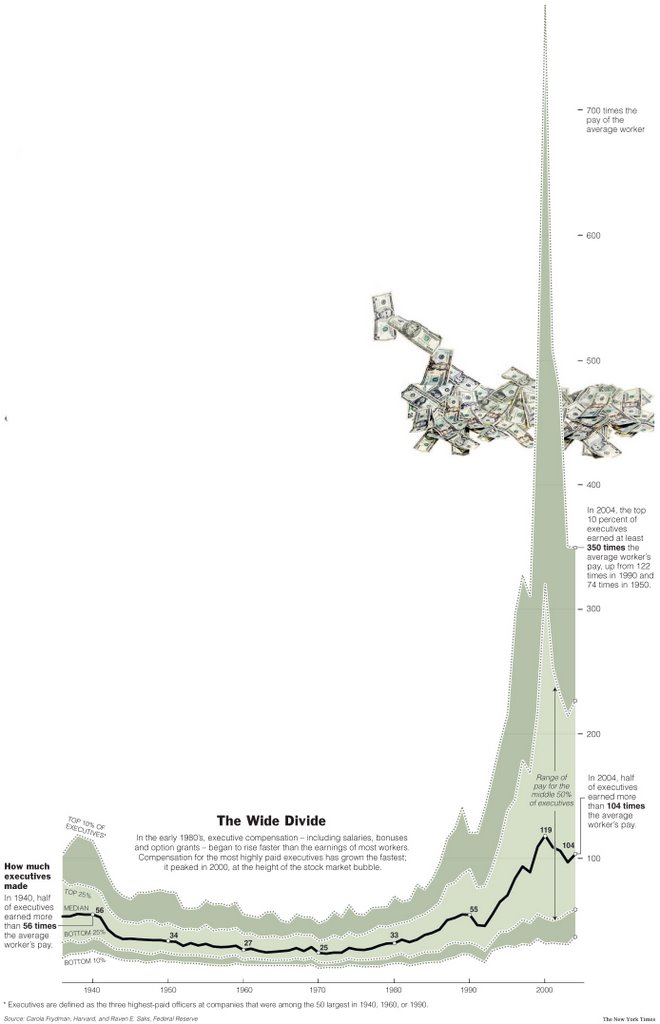 The first graph (right) shows the dramatic increase in CEO to average worker pay that has occured in the U.S. since the 1940s, with a dramatic take-off occuring in the 1990s. The numbers are mindboggiling and unique to the U.S., for other countries are no where near as high (more on this in a future post).. For instance, in 1940, half of the executives earned more than 54 times the average worker's pay and in 2004, half of the executives earned more than 104 times the average worker's pay. What is even worse is that the top 10% of executives earned 74 times the average worker's pay in 1950, in 2004 this had increased to 350.
[A] 24-hour general strike [was] called by the main public and private sector unions…There was widespread disruption to transport and public services across Greece on Wednesday…The unions called the strike as part of an escalating campaign of action over the conservative government's attempts to reform the economy…There is real discontent amongst the workforce at low wages and high prices. Union officials say the minimum wage in Greece is half the European Union average(1).It is nice to see that labor has some organization and power in the world today. The Greeks know how to stand their ground and fight for the hard won benefits that all individuals should receive. This is not just a one of occurrence either, Greek labor has been very active the past two years in striking and letting their voice and power be shown(2)(3)(4)
Dominant Culture: The values, beliefs, norms that maintain the ruling social, economic, and political interests.
Subculture: Segment of society whose values, beliefs, and norms differ from that of the dominant.
Counter Culture: A subculture whose values, beliefs and norms deliberately oppose those of the dominant culture.
a complex which springs from the commodity form of the products and which is functionally determined by EV – a complex of material phenomena and of the sensual subject-object relations conditioned by these phenomena (P.7).
For Haug commodity aesthetics has two main parts, (1) signifying beauty – appearance appealing to the senses and (2) a beauty developed in the service of the realization of EV – commodities designed to stimulate in the onlooker the desire to posses and the impulse to buy (P.8).
Appearance is detached from the material form and quality of the commodity and is embellished and altered for means of deception – promising what it is not.
“The aesthetic abstraction of the commodity detaches itself from the object acting as a carrier of exchange-value and makes the two available separately (P.50)”
“At first form and surface are merely separated – the form being cheapened while the surface appears of a higher quality or quantity. But then its image is splintered from the commodity itself – fed through the mass media – and arrives to the individual before the formal commodity every does (P.50).”The disassociation of the commodity object and commodity image has occurred.
“that manipulation can only be effective if it somehow latched on to the objective interests of those being manipulated (P.6).”
Student said: “So if capitalism has subsumed or partnered with coolness, can it survive without it? What about cultural facets, outsiders who are not part of this totality of the protestant ethic (like developing nations) that capitalism has not found a way to market/profit from?”
Student said: “So if capitalism has subsumed or partnered with coolness, can it survive without it?”
Student's question: I had wondered in recent weeks about a good working definition of mass culture. My internal assumptions, which of course could be faulty, are that (a) mass culture as is a product of the industrial, market-driven age -- i.e. that there is a recprocal relationship with the marketplace (in its abstract defition) and culture and (b) that mass culture is some kind of social remix of the low/popular, and high/authoritative cultures that, as we have seen, were divided out when certain societal hierarchies were formed. But, perhaps we can think of it as (high-culture) power's appropriation and transformation of low culture forms, which it "tames" or censors in some manner, and then reimposes it back onto the less powerful classes. So, I suppose related questions I have are: is modern mass culture a stripped-down carnival culture--non-threatening to power-- in a box? If so or even if not, who are the 'masters' of the culture and who are the 'slaves' to it, or is this even an appropriate way of thinking about it, when everyone is a consumer, even the 'masters'
"a radio ad accusing him of unfairly favoring blacks repeated the word "black" six times in its first twenty-four seconds, warning Tennesseans that he's a member of the "Congressional Black Caucus, an all-black group of congressmen who represent the interests of black people."The Nation
The Nation
"I voted for the Patriot Act, five trillion in defense, and against amnesty for illegals. I approved this message because I won't let them make me somebody I'm not. And I'll always fight for you...Junior" came to Washington preaching the New Democrats' gospel of fiscal restraint, corporate-friendliness and social moderation...In the past two Congresses, he voted the conservative line on every issue likely to matter to Tennessee voters come 2006. From being a moderate on immigration, he became one of Washington's staunchest border-warriors. He voted to extend Bush's tax cuts and supported constitutional amendments against flag-burning and gay marriage. His old F rating from the National Rifle Association turned into a B."
